
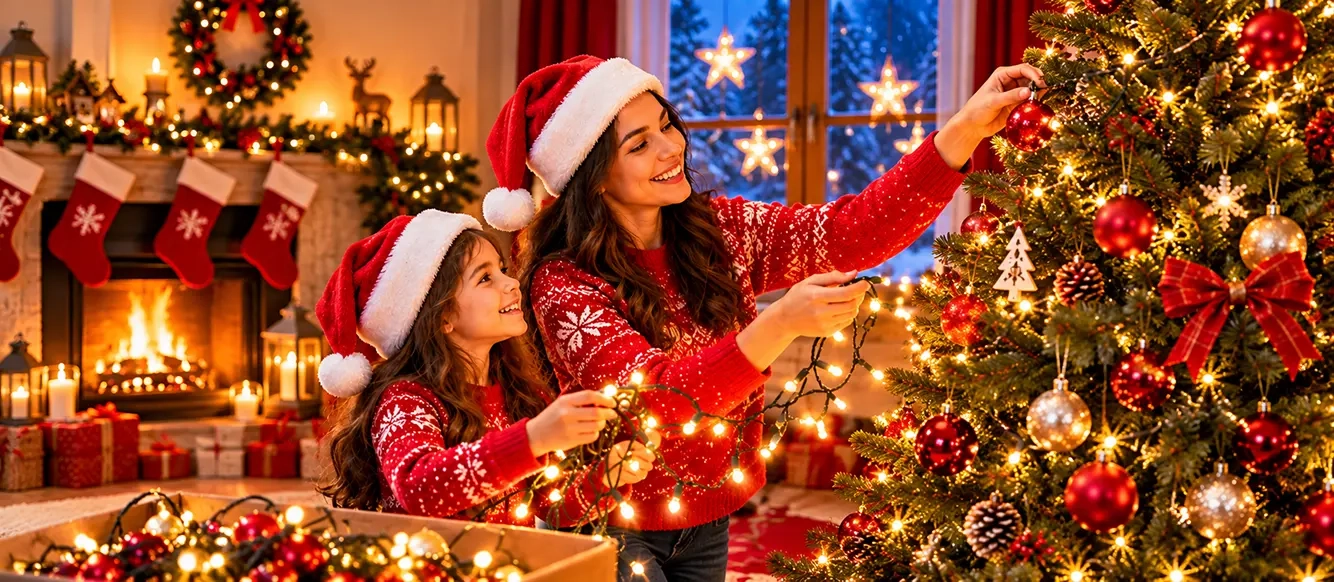
Decorating the Christmas tree is one of the most cherished holiday traditions, bringing warmth, nostalgia, and festive cheer to any home. However, when it comes to wrapping your tree in a magical holiday glow, one of the most common questions people ask is, 'How many Christmas lights for a tree do you really need?'
As a practical baseline for this guide, a helpful starting estimate is approximately 100 lights per foot of tree height. Using this guideline, a standard 6-foot Christmas tree requires around 600 lights for a classic, balanced glow.
However, there is no single rule that applies to every home. The ideal number of lights depends on several key factors:
-
The height and overall width of the tree.
-
Branch density and foliage thickness.
-
The bulb count and total length of each strand.
-
Your personal style (whether you prefer a subtle accent or a dazzling showcase).
Whether you are setting up a real evergreen or learning how to make an artificial Christmas tree look fuller, this comprehensive guide will help you calculate the exact number of lights you need, select the right light strands, apply them safely, and create a stunning centrepiece for your holiday celebrations.
How Many Christmas Lights Do You Need for Your Tree?
Determining the right light coverage can feel overwhelming when faced with rows of options at the store. Because trees vary greatly in shape, density, and profile, decorating rules are flexible guidelines rather than rigid laws.
To simplify your holiday planning, we use a simple height-based formula as a practical starting estimate:
Worked Example: A 6-Foot Christmas Tree
For a typical 6-foot living room tree, the calculation is straightforward:
This 100-lights-per-foot guideline yields a classic, evenly distributed glow that highlights both inner branches and outer greenery without overwhelming your ornaments.
However, you should adjust this number to fit your personal taste and tree type:
-
For a Subtle Glow: Reduce the target to 50–75 lights per foot (300–450 lights for a 6-foot tree).
-
For a Statement Display: Increase the count to 150–200 lights per foot (900–1,200 lights for a 6-foot tree).
-
For Slim or Pencil Trees: Reduce your total count by 20% to 30%, as narrower profiles require less wrapping distance.
-
For Full, Wide Evergreens: Increase your estimate by 20% to 30% to account for deep branches and wide lower circumferences.
Christmas Tree Light Calculator by Tree Height
To save you time, the following chart provides estimated bulb totals for standard tree sizes, calculated using our baseline of 100 lights per foot.
| Tree Height | Baseline Estimate (100 Lights/ft) | Subtle/Minimal Look (75 Lights/ft) | Dazzling/Dense Look (150 Lights/ft) |
| 4 Feet | 400 Lights | 300 Lights | 600 Lights |
| 5 Feet | 500 Lights | 375 Lights | 750 Lights |
| 6 Feet | 600 Lights | 450 Lights | 900 Lights |
| 7 Feet | 700 Lights | 525 Lights | 1,050 Lights |
| 8 Feet | 800 Lights | 600 Lights | 1,200 Lights |
| 9 Feet | 900 Lights | 675 Lights | 1,350 Lights |
| 10 Feet | 1,000 Lights | 750 Lights | 1,500 Lights |
Note: Use these figures as a starting baseline when planning your purchases. Adjust your totals according to your tree's width, foliage density, and decorating style.
What Affects the Number of Christmas Lights You Need?
While height provides a reliable starting point, several structural and aesthetic elements will influence your final light count:
-
Tree Height: Taller trees require significantly more loops to cover the extra vertical distance.
-
Tree Width: Wider, sweeping trees take longer horizontal wraps than narrow pencil trees.
-
Branch Density: Denser branches block light, requiring you to weave bulbs deeper into the interior.
-
Decorating Style: Personal taste dictates whether you prefer a subtle accent or a dazzling, bright glow.
1. Tree Height
Height is the most significant factor because it dictates how many horizontal loops you must make around the tree from the base to the top crown. As a tree grows taller, its overall surface area expands significantly.
2. Tree Width and Shape
Trees come in a variety of profiles, from slender pencil pines to full, sweeping Douglas firs. A 7-foot slim artificial tree has a much smaller circumference than a 7-foot wide Fraser fir.
-
Narrow/Slim Trees: Require fewer wraps per vertical foot.
-
Broad/Full Trees: Demand significantly more length per horizontal loop to cover wide lower branches adequately.
3. Branch Density
Foliage thickness changes how light travels through your tree:
-
Dense Trees (e.g., Noble Fir, Artificial Spruce): Thick needles block light from travelling outwards from the trunk. To achieve depth, you must weave lights deeper into the interior branches as well as across the tips.
-
Sparse Trees (e.g., Fraser Fir, Silvertip): Open branch structures allow light to pass through easily. Fewer lights are needed to illuminate the interior, though visible wires must be hidden carefully.
4. Brightness and Decorating Style
Your personal taste plays a major role in choosing the right lighting density:
-
Minimalist & Rustic: Focuses on warm, subtle accent lighting that allows natural pine needles and wooden ornaments to take centre stage.
-
Traditional & Balanced: Creates an inviting, classic aesthetic where lights and ornaments complement each other equally.
-
Maximalist & Dazzling: Uses heavy, dense lighting coverage to transform the tree into a brilliant, glowing focal point.
5. Ornaments and Other Decorations
If your tree is loaded with large heirlooms, thick tinsel, or broad ribbons, these elements will cover a portion of the foliage, potentially blocking some bulbs. Conversely, reflective glass baubles catch and amplify ambient light, making a moderately lit tree appear significantly brighter.
How Many Strands of Christmas Lights Do You Need?
Understanding the difference between individual light bulbs and light strands is essential when converting your calculations into a store shopping list. Manufacturers package lights in various configurations—such as 50, 100, 150, or 200 bulbs per strand.
To determine how many physical boxes or strands to buy, use this simple formula:
Strand Calculation Workflow
-
Determine Total Target Bulb Count: Calculate your overall need (e.g., 600 lights for a 6-foot tree).
-
Check Strand Packaging: See how many bulbs are on each strand (e.g., 150 bulbs per strand).
-
Divide Total by Strand Count: Perform the calculation ($600 \div 150 = 4$).
-
Round Up: If the calculation leaves a fraction, round up to the next whole strand.
Worked Calculation Examples
Example 1: 6-Foot Tree
-
Target Bulb Count: 600 lights
-
Strand Configuration: 150 lights per strand
-
Calculation:
$$\frac{600}{150} = 4 \text{ strands}$$
Example 2: 7-Foot Tree
-
Target Bulb Count: 700 lights
-
Strand Configuration: 100 lights per strand
-
Calculation:
$$\frac{700}{100} = 7 \text{ strands}$$
Example 3: Rounding Up for Partial Strands
-
Target Bulb Count: 800 lights (for an 8-foot tree)
-
Strand Configuration: 150 lights per strand
-
Calculation:
$$\frac{800}{150} = 5.33 \text{ strands}$$ -
Action: Round up to 6 strands (totalling 900 bulbs) to avoid running out of lights before reaching the top spire.
Tip: Always inspect box packaging to confirm strand length, bulb spacing, and end-to-end connection limits before making a final purchase.
How to Choose the Right Christmas Tree Lights
Beyond bulb counts, selecting the proper lighting technology, wire colour, and temperature dramatically impacts your final display.
LED vs. Traditional Incandescent Lights
Modern LED (Light Emitting Diode) Christmas lights have largely replaced traditional incandescent bulbs, and for good reason:
-
Energy Efficiency: LEDs consume up to 80%–90% less electricity than incandescent bulbs.
-
Cooler Operating Temperature: LEDs generate minimal heat, reducing the risk of drying out real evergreen needles.
-
Durability: Built with solid epoxy lenses rather than fragile glass filaments, making them resistant to accidental drops.
-
Longer Lifespan: Rated for tens of thousands of hours of seasonal use.
While incandescent lights offer a classic, nostalgic glow, modern LEDs are available in warm colour profiles that match traditional aesthetics perfectly.
Warm White vs. Cool White LEDs
-
Warm White: Emits a soft, golden-yellow hue similar to candlelight or incandescent bulbs. It is ideal for traditional, cosy, or vintage decorating themes featuring red, gold, and green ornaments.
-
Cool White: Produces a crisp, bright light with a subtle blue undertone. It complements modern, winter-wonderland, silver, blue, or frosted/flocked tree designs.
Multicolour Christmas Lights
Multicolour strands feature alternating red, green, blue, yellow, and orange bulbs. They add a playful, nostalgic energy to family trees, working exceptionally well with colourful children's crafts and whimsical holiday themes.
Wire Colour and Bulb Spacing
-
Wire Colour: Choose green wire for real or traditional green artificial trees, white wire for flocked or white artificial trees, and dark wire for black or alternative modern trees. Matching the wire colour ensures electrical cords blend seamlessly into the background.
-
Bulb Spacing: Standard strands feature bulbs spaced 4 to 6 inches apart. Tighter spacing (2 to 4 inches) yields a denser, brighter glow with less cord management required.
Indoor vs. Outdoor Ratings
Always verify that your selected lights carry an Indoor Use or Indoor/Outdoor Use safety rating from a recognised testing laboratory (such as UL or ETL). Never use outdoor-only heavy-duty light sets on indoor artificial trees if they are not rated for indoor residential safety compliance.
How to Put Lights on a Christmas Tree: Step-by-Step
Installing lights systematically saves time, prevents tangled cords, and ensures even coverage from trunk to tip.
-
Step 1 (Test First): Inspect cords and plug in strands on the floor to verify all bulbs work before decorating.
-
Step 2 (Set Power Connection): Plug the first strand near the wall outlet or extension cord at the base.
-
Step 3 (Work Bottom-to-Top): Start at the bottom of the trunk and wrap upward toward the top crown.
-
Step 4 (Weave for Depth): Trace strands inward along branches toward the trunk and back out to the tips to create 3D depth.
-
Step 5 (Check & Adjust): Step back 6–8 feet and squint to spot any dark areas or overcrowding.
-
Step 6 (Add Ornaments Last): Hang baubles, garlands, and toppers only after light distribution is balanced.
1. Test Your Lights First
Before stepping near the tree, unravel each strand, plug it into an outlet, and verify that all bulbs illuminate properly. It is far easier to replace a blown fuse or burnt-out bulb while the strand is on the floor than after it is woven into branch needles.
2. Establish Your Power Connection
Plug the first strand into your wall outlet or extension cord near the base of the tree. Ensure extension cords are placed safely away from high-traffic walkways to prevent tripping hazards.
3. Work From the Bottom Up
Start wrapping at the base of the trunk and move upward toward the top spire. This keeps heavy connection plugs near the ground and ensures the tail end of your last strand reaches the top crown neatly.
4. Create Depth with Inner and Outer Weaving
Instead of simply circling the outer perimeter of the branches like a cage, weave the light strands back and forth along the length of each major branch:
-
Extend the strand from the trunk outward along a branch toward the tip.
-
Wrap around the branch tip once to secure it.
-
Trace the strand back inward toward the center trunk before moving up to the next branch level.
This three-dimensional technique illuminates the tree from within, creating depth and hiding visible green cords.
5. Step Back and Adjust
Periodically step back 6 to 8 feet from the tree and squint your eyes slightly. This blurs the individual details and highlights any noticeable "dark spots" or overcrowded areas that need repositioning.
6. Add Ornaments Last
Always finish placing and adjusting your light strands before hanging ornaments, garlands, or tree toppers. If you are making custom decorations this season, explore our creative collection of Christmas DIY decoration ideas to complement your lighting design.
Christmas Tree Lighting Safety Tips
While Christmas lights add magical cheer to the home, electrical safety should always remain a top priority throughout the holiday season.
-
Inspect Cords Thoroughly: Discard any light strands showing frayed insulation, exposed copper wires, cracked sockets, or loose connections.
-
Observe Strand Limits: Never connect more strands end-to-end than the manufacturer specifies on the product box. Traditional incandescent lights typically limit connections to 3–5 strands, whereas low-wattage LEDs can often connect 20 or more strands safely.
-
Avoid Outlet Overloading: Do not plug too many high-wattage appliances or light sets into a single wall receptacle or lightweight extension cord.
-
Turn Off Lights When Unattended: Always switch off your Christmas tree lights before going to sleep or leaving your home. Consider using an automatic appliance timer or smart plug to handle shutdown schedules seamlessly.
-
Keep Real Trees Watered: If decorating a natural cut tree, check the water reservoir daily. Dry pine needles combined with warm electrical components present a serious fire hazard.
-
Maintain Safe Clearances: Position your illuminated tree at least 3 feet away from space heaters, fireplaces, radiators, candles, and other heat sources.
Conclusion
Decorating your Christmas tree should be a joyful, stress-free tradition that brings your household together. By starting with the baseline estimate of 100 lights per foot of tree height, adjusting for your tree's unique shape and foliage density, and following proper installation steps, you can create a perfectly balanced, glowing holiday display.
As you prepare your home for the holidays, keep track of the remaining prep time with our live Christmas countdown, download festive seasonal backgrounds from our Christmas wallpapers collection, or browse more expert decorating guides on the XmasApplication blog!